
Unreal Engine alternatives
Top Game Engines like Unreal Engine
The most popular alternative to Unreal Engine is Unity, which has a free version. Other great alternatives to Unreal Engine are Godot Engine, Defold, GameMaker, and GDevelop.
Most alternatives to Unreal Engine are in the Game Engines category, compared here by price, platform and features.
All Unreal Engine alternatives
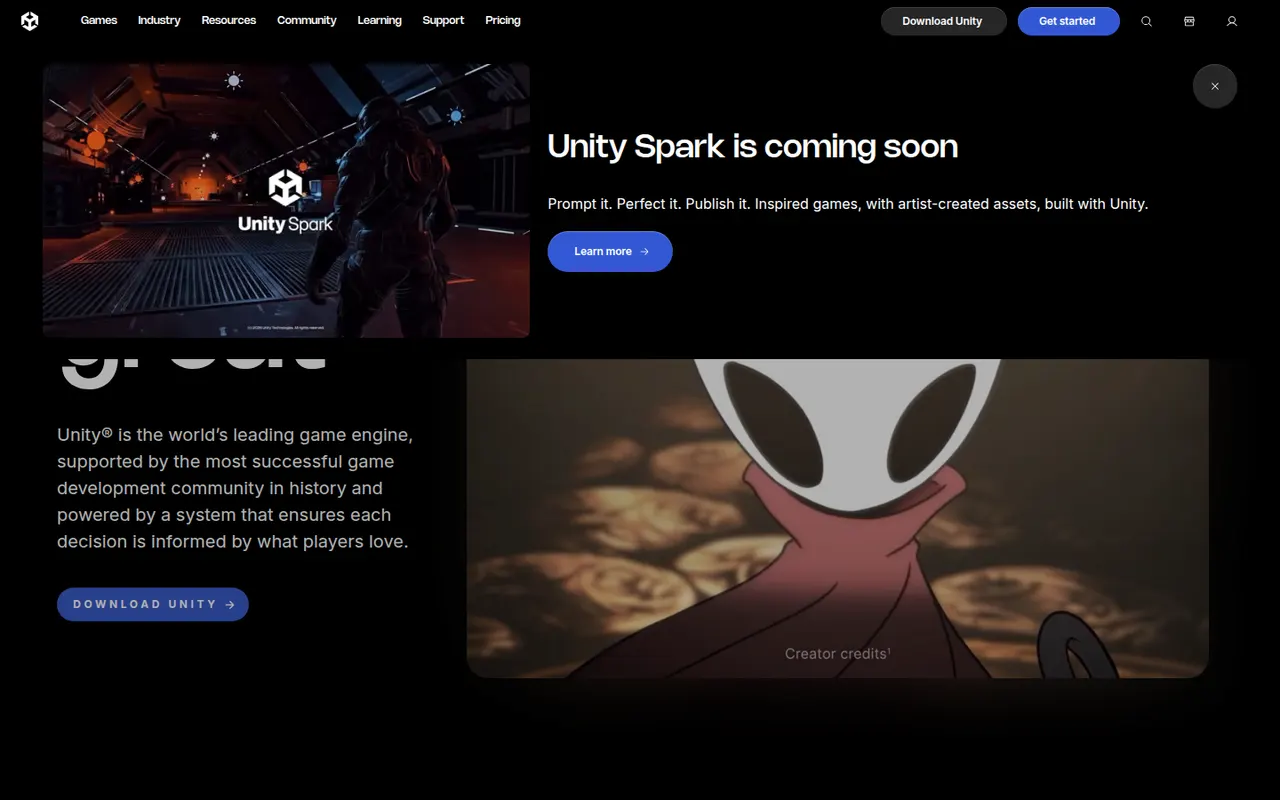
Unity is a game engine and editor used to build 2D, 3D, mobile, console, VR and AR games and interactive applications, scripted in C# or with its built-in visual scripting. It exports to a wide range of platforms, from phones and PCs to consoles and headsets, and the Asset Store offers ready-made tools, models and templates. A free Personal plan exists, with paid Pro and Enterprise tiers above a revenue threshold.
8 Unity alternativesPros
- Exports to almost every platform, from phones to consoles and headsets
- Huge Asset Store, extensive documentation and a large community
- C# scripting plus visual scripting, for both 2D and 3D
Cons
- Past licensing changes have shaken trust among developers
- Editor can feel heavy and slow on large projects
- Paid tiers become mandatory above a revenue threshold
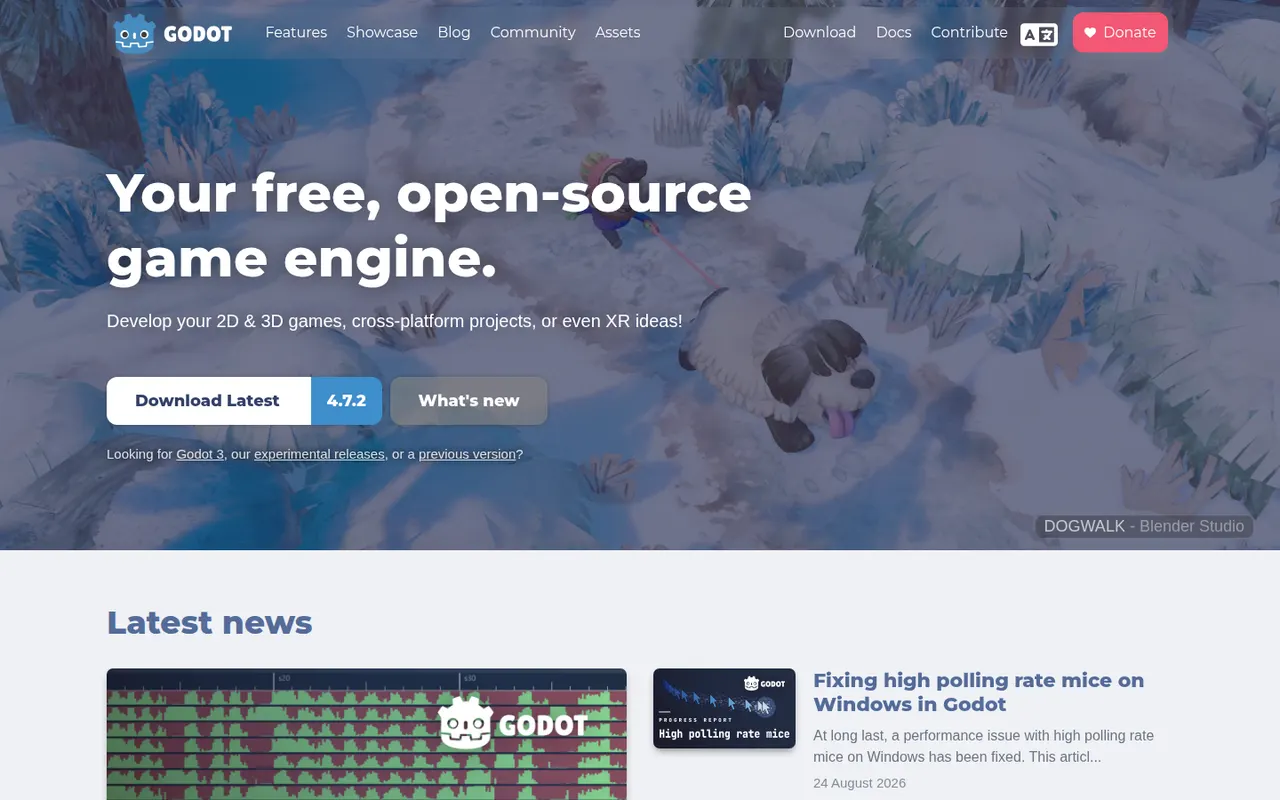
Cost / LicenseFreemiumProprietaryCategoriesGodot is a free, open source game engine released under the MIT license, with no royalties or fees. It provides dedicated 2D and 3D renderers, a scene and node system, its own Python-like GDScript language plus C# support, and a lightweight editor for Windows, macOS and Linux. Games export to desktop, mobile and the web, while console ports go through third-party partners. It is backed by the Godot Foundation.
7 Godot Engine alternativesPros
- MIT licensed, with no royalties, fees or revenue thresholds
- Lightweight editor with a dedicated 2D renderer, not 3D in disguise
- Easy-to-learn GDScript, C# support and a clean scene and node system
Cons
- Console ports have to go through third-party partners
- Asset store and third-party ecosystem are smaller than Unity’s
- High-end 3D rendering still trails Unreal and Unity
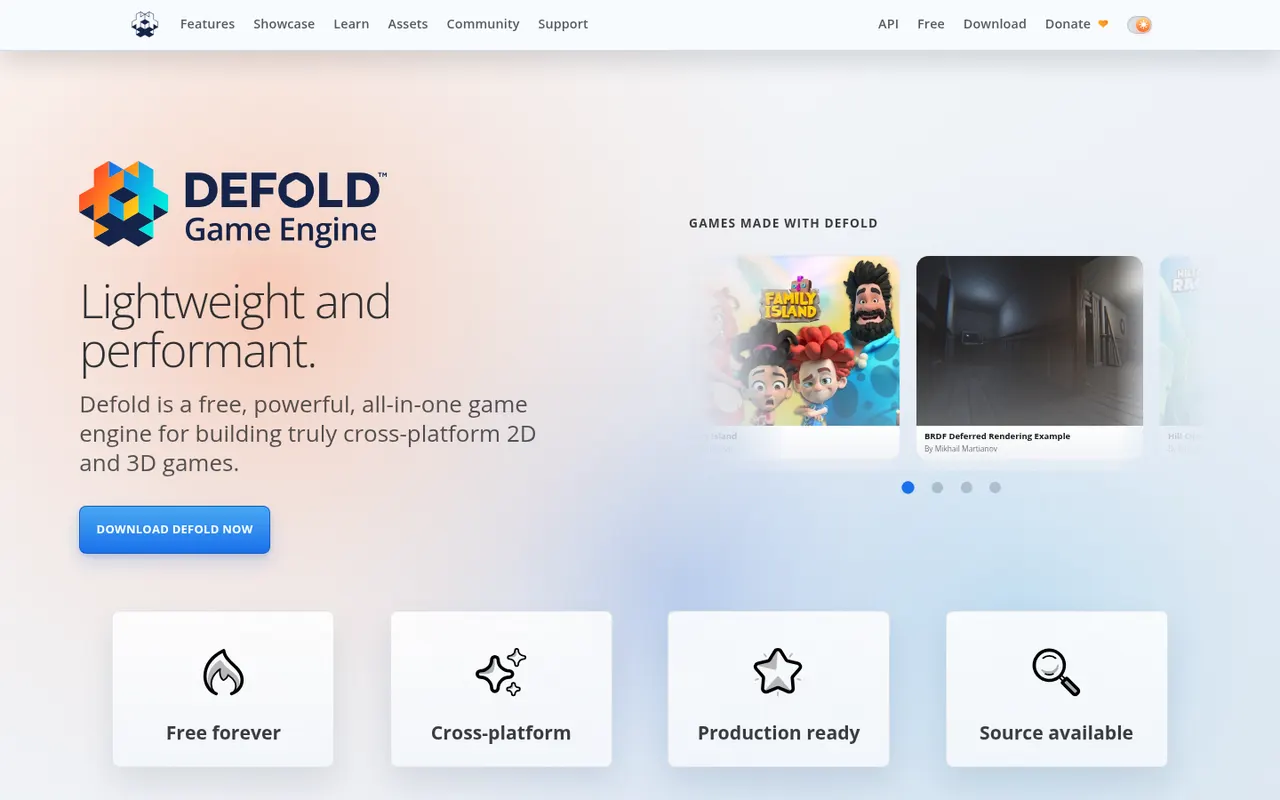
Cost / LicenseFreeOpen sourceCategoriesDefold is a free game engine first released by King and now maintained by the independent Defold Foundation. It is known for small build sizes and fast iteration, uses Lua for scripting and exports to Windows, macOS, Linux, iOS, Android and HTML5, with console support available to approved developers. Its source code is public on GitHub under the Defold License, a permissive license with some restrictions.
7 Defold alternativesPros
- Free to use with no royalties, backed by an independent foundation
- Small build sizes and fast iteration, ideal for mobile and web games
- Lightweight Lua scripting and broad export targets including HTML5
Cons
- Smaller community and fewer tutorials than Unity or Godot
- 3D tooling is basic, as the engine shines mostly in 2D
- No visual scripting, so coding in Lua is required
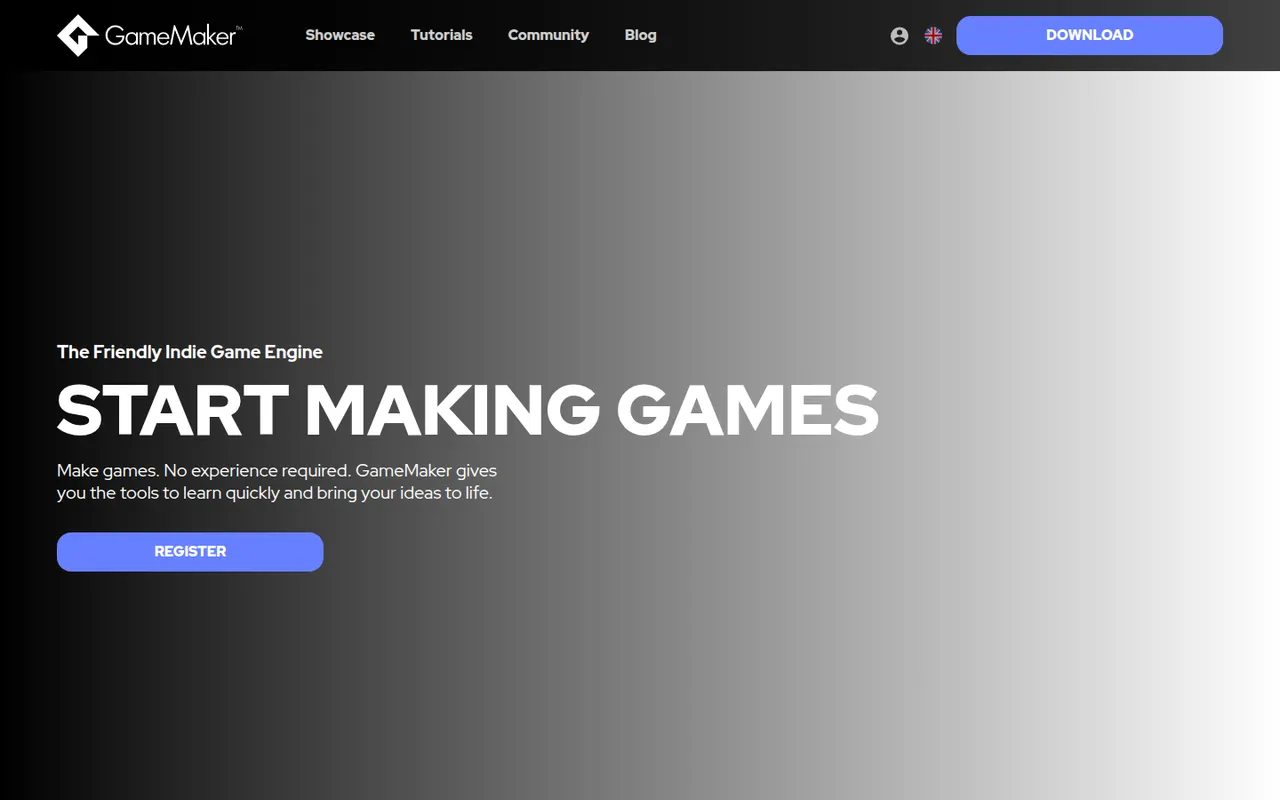
Cost / LicenseFreeSource availableCategoriesGameMaker is a 2D game engine owned by Opera, used by indie developers and beginners to create platformers, RPGs and arcade games. Logic can be written in GML Code or built with GML Visual, a drag-and-drop system, and projects export to desktop, mobile, web and consoles. It is free for non-commercial use, with paid licenses for commercial releases and console export.
7 GameMaker alternativesPros
- Beginner-friendly, with GML Visual drag-and-drop alongside GML Code
- Mature, focused toolset for 2D platformers, RPGs and arcade games
- Exports to desktop, mobile, web and consoles
Cons
- Commercial releases and console export require paid licenses
- Not suited to 3D projects
- GML is specific to the engine, so skills transfer less easily elsewhere
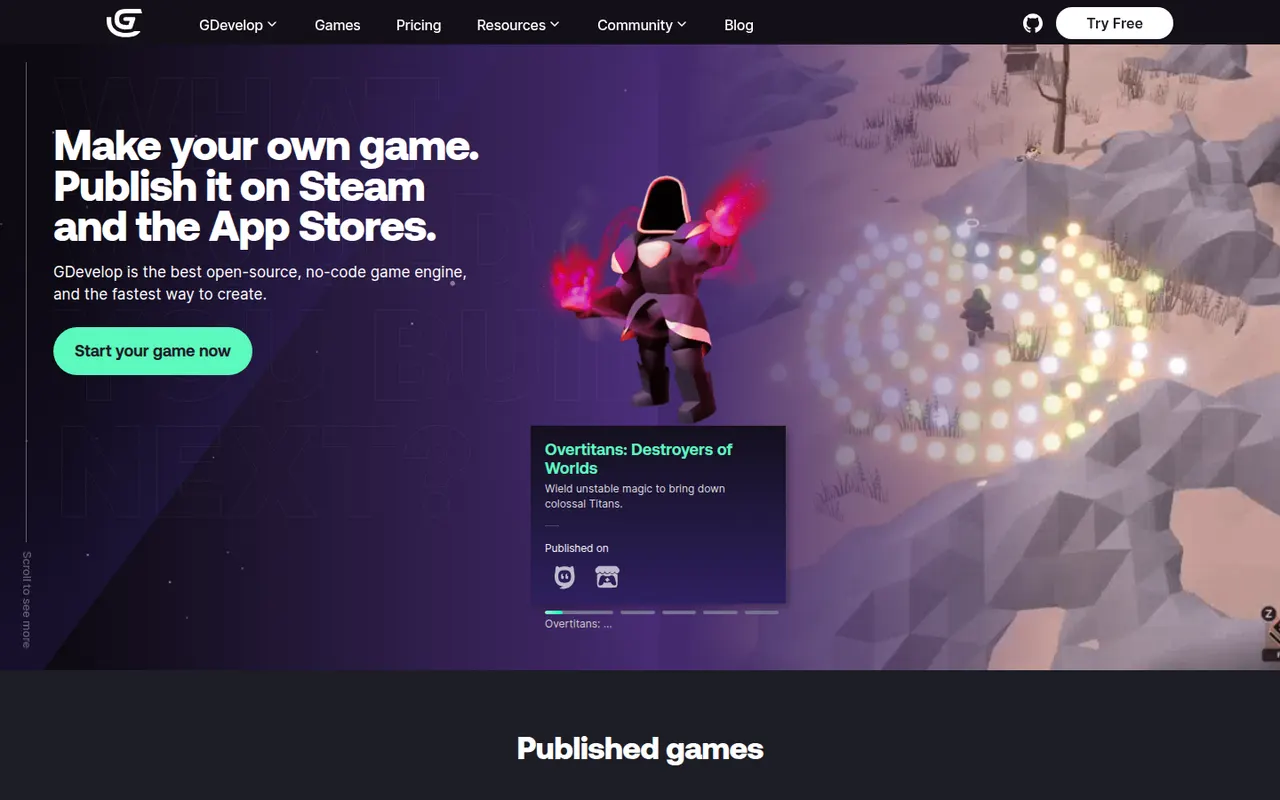
Cost / LicenseFreemiumProprietaryCategoriesGDevelop is a free, open source game engine that lets creators build 2D and 3D games with an event-based visual logic system instead of code. It runs in the browser or as a desktop app, includes templates, an asset store and ready-made behaviors for platformers, physics and pathfinding, and exports to web, Windows, macOS, Linux, Android and iOS. Optional subscriptions add cloud builds and other services.
7 GDevelop alternativesPros
- Free and open source, usable in the browser or as a desktop app
- Event-based logic and ready-made behaviors avoid writing code
- Exports to web, desktop, Android and iOS
Cons
- 3D support is newer and less mature than its 2D tools
- Cloud builds and some services require a subscription
- Complex games can outgrow the event system
Cost / LicenseFreemiumOpen sourceCategoriesConstruct 3 is a 2D game engine from Scirra that runs in the web browser and uses event sheets, a visual logic system, so games can be built without traditional programming, with optional JavaScript for advanced users. Games export to HTML5 and to desktop and mobile apps. It is used in schools and by hobbyists and indie developers, with a limited free edition and paid subscriptions for the full feature set.
7 Construct 3 alternativesPros
- Runs in the browser, so there is nothing to install
- Event sheets let beginners build games without writing code
- Exports to HTML5, desktop and mobile from one project
Cons
- Built for 2D games, with minimal 3D capabilities
- Free edition is limited and the full version is subscription-only
- Large projects can become hard to organize with event sheets
Cost / LicenseFreemiumProprietaryCategoriesPlatformsHoudini is a 3D animation and visual effects application from SideFX built on a node-based procedural workflow, where every step stays editable. Studios use it for simulations such as fire, smoke, fluids, destruction and crowds, and game developers use it to generate environments and assets procedurally. A free Apprentice edition allows non-commercial learning, alongside paid Indie and studio licenses.
7 Houdini alternativesPros
- Node-based procedural workflow keeps every step editable
- Leading toolset for fire, smoke, fluid and destruction simulations
- Free Apprentice edition for non-commercial learning
Cons
- One of the steepest learning curves among 3D applications
- The free edition watermarks renders and is non-commercial only
- Overkill for simple modeling or quick motion graphics jobs
Cost / LicenseFreemiumProprietaryCategoriesAutodesk Maya is a 3D application used in film, television and game studios for character animation, rigging, modeling, simulation and visual effects. It includes the Arnold renderer, Bifrost for procedural effects and simulations, and Python and MEL scripting for building custom pipelines. It runs on Windows, macOS and Linux, and free educational licenses are available to students.
6 Autodesk Maya alternativesPros
- Industry-standard tools for character animation and rigging
- Python and MEL scripting for building custom studio pipelines
- Runs on Windows, macOS and Linux, with free licenses for students
Cons
- Subscription pricing is steep for freelancers and small studios
- Dense interface with a long learning curve for beginners
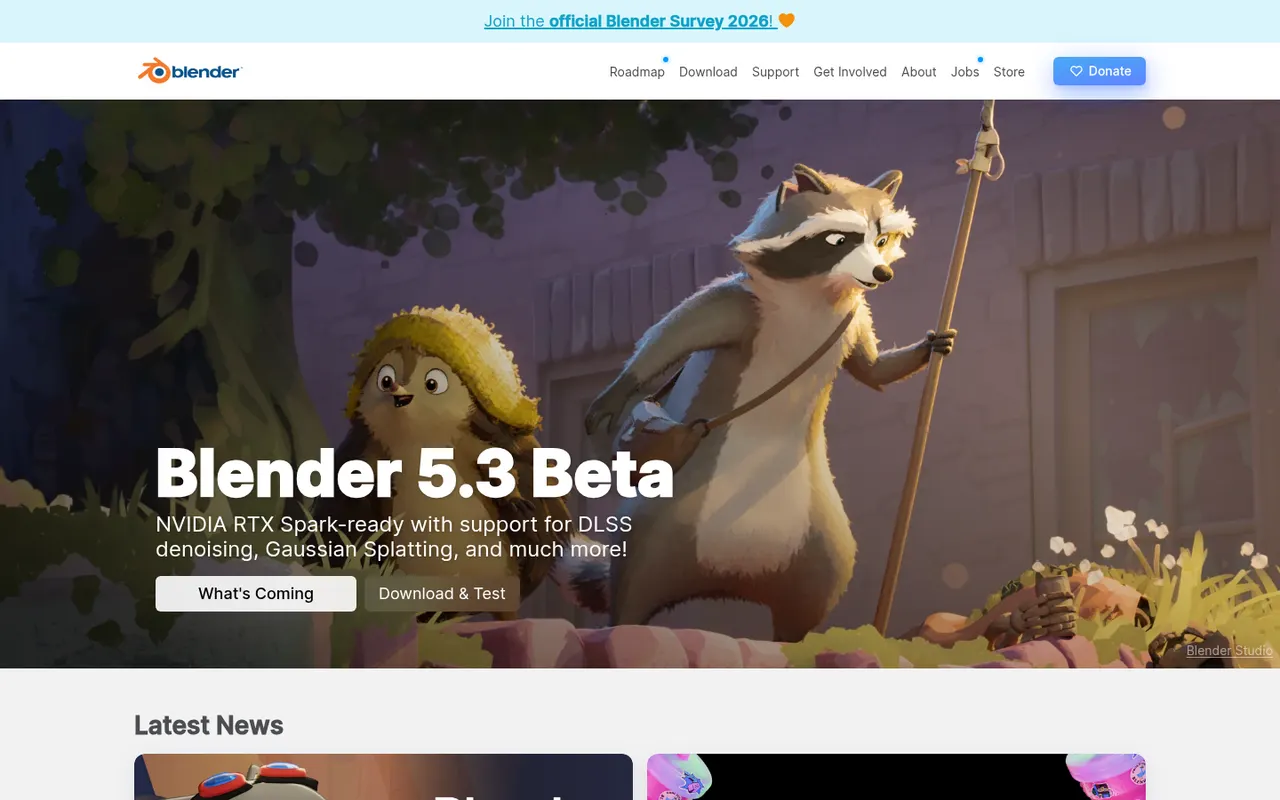
Cost / LicenseFree trialProprietaryCategoriesBlender is a free, open source 3D creation suite covering modeling, sculpting, rigging, animation, simulation, rendering with Cycles and EEVEE, compositing and video editing. Its Grease Pencil tools also allow 2D animation inside a 3D space. Developed by the Blender Foundation and a large community, it is used by hobbyists, studios and game developers and can be extended with Python add-ons.
12 Blender alternativesPros
- Completely free and open source, with no license or subscription
- Covers modeling, sculpting, animation, rendering and video editing
- Large community with countless tutorials and Python add-ons
Cons
- Dense interface that takes newcomers time to learn
- Less established than Maya or 3ds Max in some studio pipelines
Cost / LicenseFreeOpen sourceCategories
















Unreal Engine vs its alternatives at a glance
Pricing, platforms and the key features of Unreal Engine, compared with its most popular alternatives.
| App | Pricing | Platforms | 3D games | Console export | Plugins & extensions | Visual scripting |
|---|---|---|---|---|---|---|
 Unreal Engine Unreal Engine | FreemiumSource available | Windows, Mac, Linux | ||||
 Unity Unity | Freemium | Windows, Mac, Linux | ||||
 Godot Engine Godot Engine | FreeOpen source | Windows, Mac, Linux | ||||
| Defold | FreeSource available | Windows, Mac, Linux | ||||
 GameMaker GameMaker | Freemium | Windows, Mac | ||||
 GDevelop GDevelop | FreemiumOpen source | Web, Windows, Mac, Linux |
Unreal Engine alternatives: frequently asked questions
What is the best alternative to Unreal Engine?
The most popular alternative to Unreal Engine is Unity: Cross-platform engine for building 2D, 3D, mobile and XR games. Other great alternatives are Godot Engine, Defold, GameMaker, and GDevelop.
Is there a free alternative to Unreal Engine?
Yes, 8 alternatives are free or have a free plan, including Unity, Godot Engine, Defold, and GameMaker.
Is there an open source alternative to Unreal Engine?
Yes, 3 open source alternatives are listed, including Godot Engine, GDevelop, and Blender.
Is Unreal Engine free?
Unreal Engine has a free plan, with paid plans that unlock more features.
Compare Unreal Engine with its alternatives


Sponsored listings and products made by the publisher of this site are always labeled. How we rank · Know a good alternative? Submit it