
Free Unity alternatives
Top Game Engines like Unity
The most popular alternative to Unity is Unreal Engine, which has a free version. Other great alternatives to Unity are Godot Engine, GameMaker, Defold, and GDevelop.
Most alternatives to Unity are in the Game Engines category, compared here by price, platform and features.
All Unity alternatives
Unreal Engine is a real-time 3D engine from Epic Games used for games as well as virtual production, architectural visualization and automotive design. It offers Blueprints visual scripting alongside C++, Nanite geometry, Lumen dynamic lighting and export to PC, consoles and mobile. Its source code is available on GitHub under Epic's license; use is free until revenue thresholds trigger royalties or seat fees.
9 Unreal Engine alternativesPros
- Top-tier visuals with Nanite geometry and Lumen lighting
- Blueprints let designers build logic without writing C++
- Full source code access on GitHub
Cons
- Demanding hardware requirements and very large project sizes
- Steep learning curve, especially on the C++ side
- Royalties or seat fees apply past revenue thresholds
Cost / LicenseFreemiumSource availableCategoriesGodot is a free, open source game engine released under the MIT license, with no royalties or fees. It provides dedicated 2D and 3D renderers, a scene and node system, its own Python-like GDScript language plus C# support, and a lightweight editor for Windows, macOS and Linux. Games export to desktop, mobile and the web, while console ports go through third-party partners. It is backed by the Godot Foundation.
7 Godot Engine alternativesPros
- MIT licensed, with no royalties, fees or revenue thresholds
- Lightweight editor with a dedicated 2D renderer, not 3D in disguise
- Easy-to-learn GDScript, C# support and a clean scene and node system
Cons
- Console ports have to go through third-party partners
- Asset store and third-party ecosystem are smaller than Unity’s
- High-end 3D rendering still trails Unreal and Unity
Cost / LicenseFreeOpen sourceCategoriesGameMaker is a 2D game engine owned by Opera, used by indie developers and beginners to create platformers, RPGs and arcade games. Logic can be written in GML Code or built with GML Visual, a drag-and-drop system, and projects export to desktop, mobile, web and consoles. It is free for non-commercial use, with paid licenses for commercial releases and console export.
7 GameMaker alternativesPros
- Beginner-friendly, with GML Visual drag-and-drop alongside GML Code
- Mature, focused toolset for 2D platformers, RPGs and arcade games
- Exports to desktop, mobile, web and consoles
Cons
- Commercial releases and console export require paid licenses
- Not suited to 3D projects
- GML is specific to the engine, so skills transfer less easily elsewhere
Cost / LicenseFreemiumProprietaryCategoriesDefold is a free game engine first released by King and now maintained by the independent Defold Foundation. It is known for small build sizes and fast iteration, uses Lua for scripting and exports to Windows, macOS, Linux, iOS, Android and HTML5, with console support available to approved developers. Its source code is public on GitHub under the Defold License, a permissive license with some restrictions.
7 Defold alternativesPros
- Free to use with no royalties, backed by an independent foundation
- Small build sizes and fast iteration, ideal for mobile and web games
- Lightweight Lua scripting and broad export targets including HTML5
Cons
- Smaller community and fewer tutorials than Unity or Godot
- 3D tooling is basic, as the engine shines mostly in 2D
- No visual scripting, so coding in Lua is required
Cost / LicenseFreeSource availableCategoriesGDevelop is a free, open source game engine that lets creators build 2D and 3D games with an event-based visual logic system instead of code. It runs in the browser or as a desktop app, includes templates, an asset store and ready-made behaviors for platformers, physics and pathfinding, and exports to web, Windows, macOS, Linux, Android and iOS. Optional subscriptions add cloud builds and other services.
7 GDevelop alternativesPros
- Free and open source, usable in the browser or as a desktop app
- Event-based logic and ready-made behaviors avoid writing code
- Exports to web, desktop, Android and iOS
Cons
- 3D support is newer and less mature than its 2D tools
- Cloud builds and some services require a subscription
- Complex games can outgrow the event system
Cost / LicenseFreemiumOpen sourceCategoriesConstruct 3 is a 2D game engine from Scirra that runs in the web browser and uses event sheets, a visual logic system, so games can be built without traditional programming, with optional JavaScript for advanced users. Games export to HTML5 and to desktop and mobile apps. It is used in schools and by hobbyists and indie developers, with a limited free edition and paid subscriptions for the full feature set.
7 Construct 3 alternativesPros
- Runs in the browser, so there is nothing to install
- Event sheets let beginners build games without writing code
- Exports to HTML5, desktop and mobile from one project
Cons
- Built for 2D games, with minimal 3D capabilities
- Free edition is limited and the full version is subscription-only
- Large projects can become hard to organize with event sheets
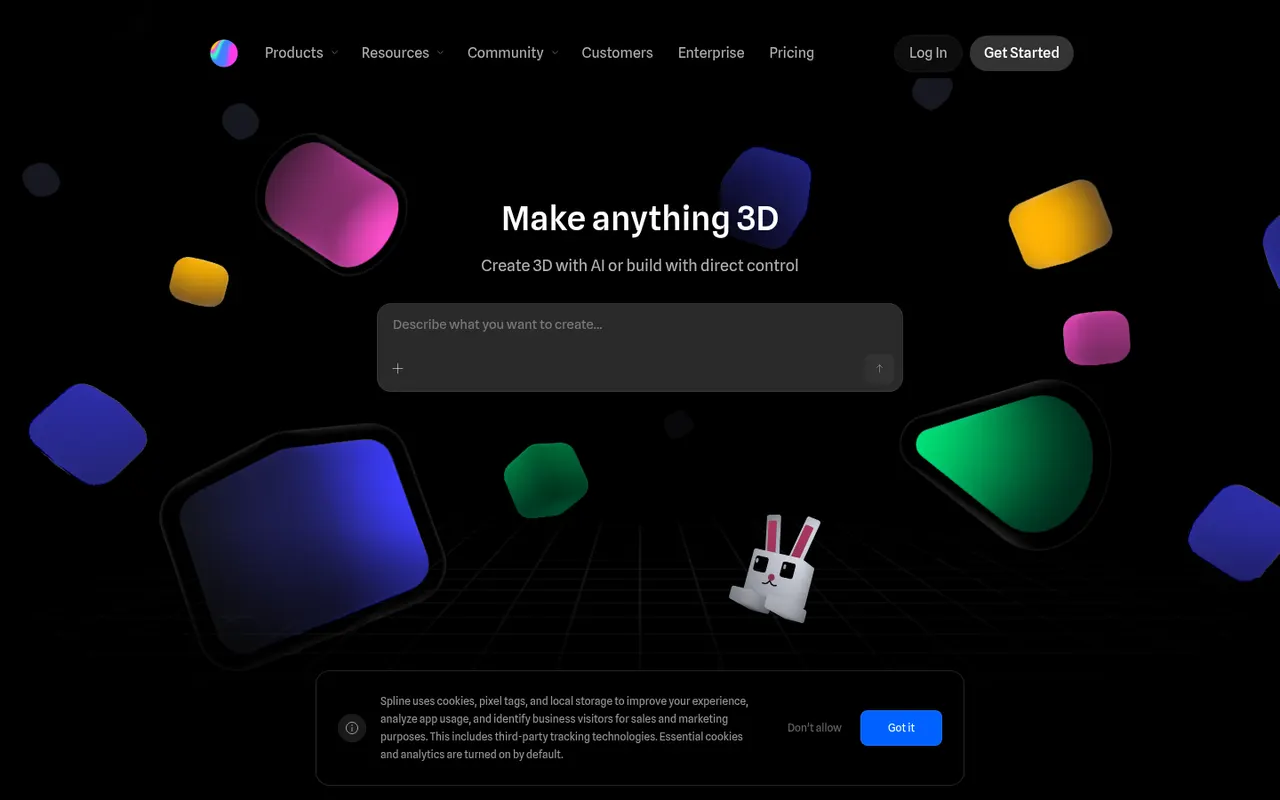
Cost / LicenseFreemiumProprietaryCategoriesPlatformsSpline is a collaborative 3D design tool that runs in the browser, aimed at designers who want to create interactive 3D scenes, animations and interface elements without learning traditional 3D software. Scenes can react to hover, scroll and clicks, and can be exported as embeddable web code, images or videos, or used in Framer, Webflow and React projects. Teams edit files together in real time.
8 Spline alternativesPros
- Lets designers create 3D scenes without traditional 3D software
- Interactive states respond to hover, scroll and clicks
- Exports to web embeds, Framer, Webflow and React projects
Cons
- Complex scenes can weigh down web pages and slow loading
- Less capable than full 3D suites for detailed modeling
- Advanced exports and team features require a paid plan
Cost / LicenseFreemiumProprietaryPlatforms












Unity vs its alternatives at a glance
Pricing, platforms and the key features of Unity, compared with its most popular alternatives.
| App | Pricing | Platforms | 2D games | 3D games | Console export | Plugins & extensions | Visual scripting |
|---|---|---|---|---|---|---|---|
 Unity Unity | Freemium | Windows, Mac, Linux | |||||
 Unreal Engine Unreal Engine | FreemiumSource available | Windows, Mac, Linux | |||||
 Godot Engine Godot Engine | FreeOpen source | Windows, Mac, Linux | |||||
 GameMaker GameMaker | Freemium | Windows, Mac | |||||
| Defold | FreeSource available | Windows, Mac, Linux | |||||
 GDevelop GDevelop | FreemiumOpen source | Web, Windows, Mac, Linux |
Unity alternatives: frequently asked questions
What is the best alternative to Unity?
The most popular alternative to Unity is Unreal Engine: Real-time 3D engine from Epic Games for games, film and visualization. Other great alternatives are Godot Engine, GameMaker, Defold, and GDevelop.
Is there a free alternative to Unity?
Yes, 7 alternatives are free or have a free plan, including Unreal Engine, Godot Engine, GameMaker, and Defold.
Is there an open source alternative to Unity?
Yes, 2 open source alternatives are listed, including Godot Engine and GDevelop.
Is Unity free?
Unity has a free plan, with paid plans that unlock more features.
Compare Unity with its alternatives


Sponsored listings and products made by the publisher of this site are always labeled. How we rank · Know a good alternative? Submit it